
Quick Facts
- Discovery Date: June–July 2019
- Location: Nyet Bruk, Braldu Valley, Pakistan
- Weight: Nearly 200 kilograms
- Type: Aquamarine crystals on albite and microcline matrix
- Public Debut: Tucson Gem & Mineral Show, January 2020
Discovery in the Mountains of Pakistan
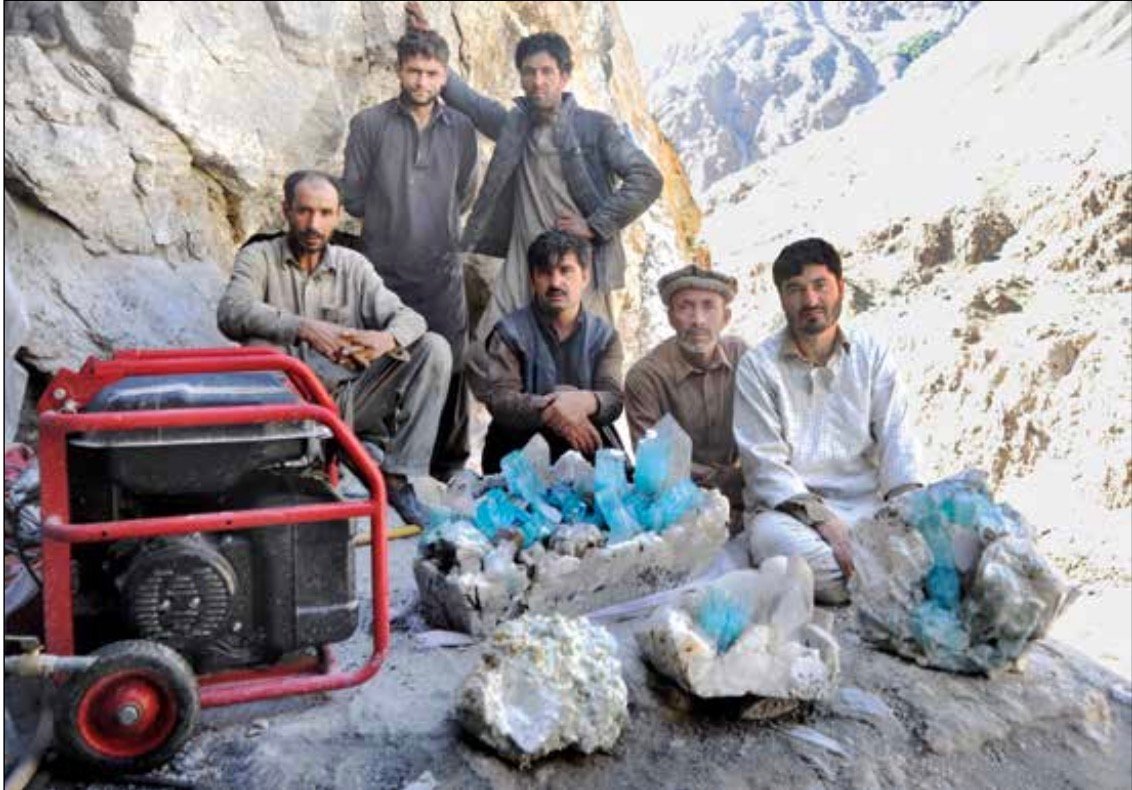
In June 2019, miners working high above the Braldu Valley ranges of the Shigar Valley region of Pakistan uncovered one of the most significant aquamarine specimens ever recorded.
The discovery took place in the Nyet Bruk region, inside a tunnel carved into a steep mountain face nearly 300 meters above the valley floor.
Inside a mineral pocket, miners found a cluster of approximately 30 aquamarine crystals attached to a white matrix of albite and microcline, mixed with quartz. The crystals were large, transparent, and naturally positioned on their host rock — a rare combination in mineral collecting.
Why This Aquamarine Is Considered Unique
Collectors often search for aquamarine crystals with:
- Strong blue color
- High transparency
- Geometric crystal form
- Intact matrix
Most large aquamarines are found loose or detached from their host rock. Specimens combining size, color and full matrix attachment are uncommon.
The King of Kashmir specimen preserved all these features in a single formation.
Extraction at Extreme Altitude
Once informed, mineral dealer Daniel Trinchillo and engineer Marco Amabili coordinated a technical extraction process.
Reaching the site required:
- Four hours by vehicle from Skardu
- A rope-supported climb up a near-vertical cliff
- Entry into a narrow mountain tunnel
Over two weeks, the team carefully cut the specimen free using diamond chainsaws and precision drilling. The goal was to remove the cluster without damaging any crystals.
The specimen weighed nearly 200 kilograms when removed. It was lowered by steel cable down the cliff face and transported safely from the site.
Reassembly and Preparation
Several large crystals had detached naturally within the pocket over geological time. These loose pieces were collected and later matched to their original positions.
After transport to Milan’s MCP preparation laboratory, the specimen underwent:
- Chemical cleaning
- Structural stabilization
- Careful trimming of excess rock
- Reassembly of detached crystals
After final adjustments, the specimen retained its full visual balance while preserving the integrity of the matrix.
Debut at the Tucson Gem & Mineral Show
The King of Kashmir made its public debut at the Tucson Gem & Mineral Show in January 2020.
Collectors and mineral specialists described it as one of the most important aquamarine specimens ever presented at the show.
Its combination of size, crystal clarity, and intact matrix set it apart from previous finds.
Geological Significance
The Shigar Valley region in Pakistan is known for producing high-quality aquamarine crystals. However, most specimens are found as single crystals rather than intact clusters on matrix.
The King of Kashmir demonstrates:
- Stable crystal growth within a pocket environment
- Strong mineral associations with albite and microcline
- Exceptional preservation despite tectonic activity
It remains one of the most studied aquamarine matrix specimens from the region.
Why It Matters to Collectors
For mineral collectors, matrix specimens hold added value because they show how crystals formed naturally.
The King of Kashmir:
- Preserved natural positioning
- Maintained structural balance
- Avoided artificial reconstruction
- Represented a rare example of responsible extraction
Its survival was partly due to the miners’ decision to seek professional extraction assistance rather than remove individual crystals.
FAQs
Q. Where was the King of Kashmir aquamarine found?
A. It was discovered in Nyet Bruk, Braldu Valley, Pakistan.
Q. How heavy is the specimen?
A. The final specimen weighs just under 200 kilograms.
Q. When was it first displayed publicly?
A. It debuted at the Tucson Gem & Mineral Show in January 2020.
Q. Why is it considered unique?
A. It combines large, transparent aquamarine crystals with a fully preserved natural matrix.
Q. Is it the largest aquamarine ever found?
A. It is regarded as one of the largest and finest aquamarine clusters preserved on matrix.
Conclusion
The King of Kashmir remains one of the most significant aquamarine discoveries of the 21st century. Found in 2019 and unveiled in 2020, the specimen continues to be referenced in mineral collecting circles in 2026 for its preservation, scale and geological importance.